



Description
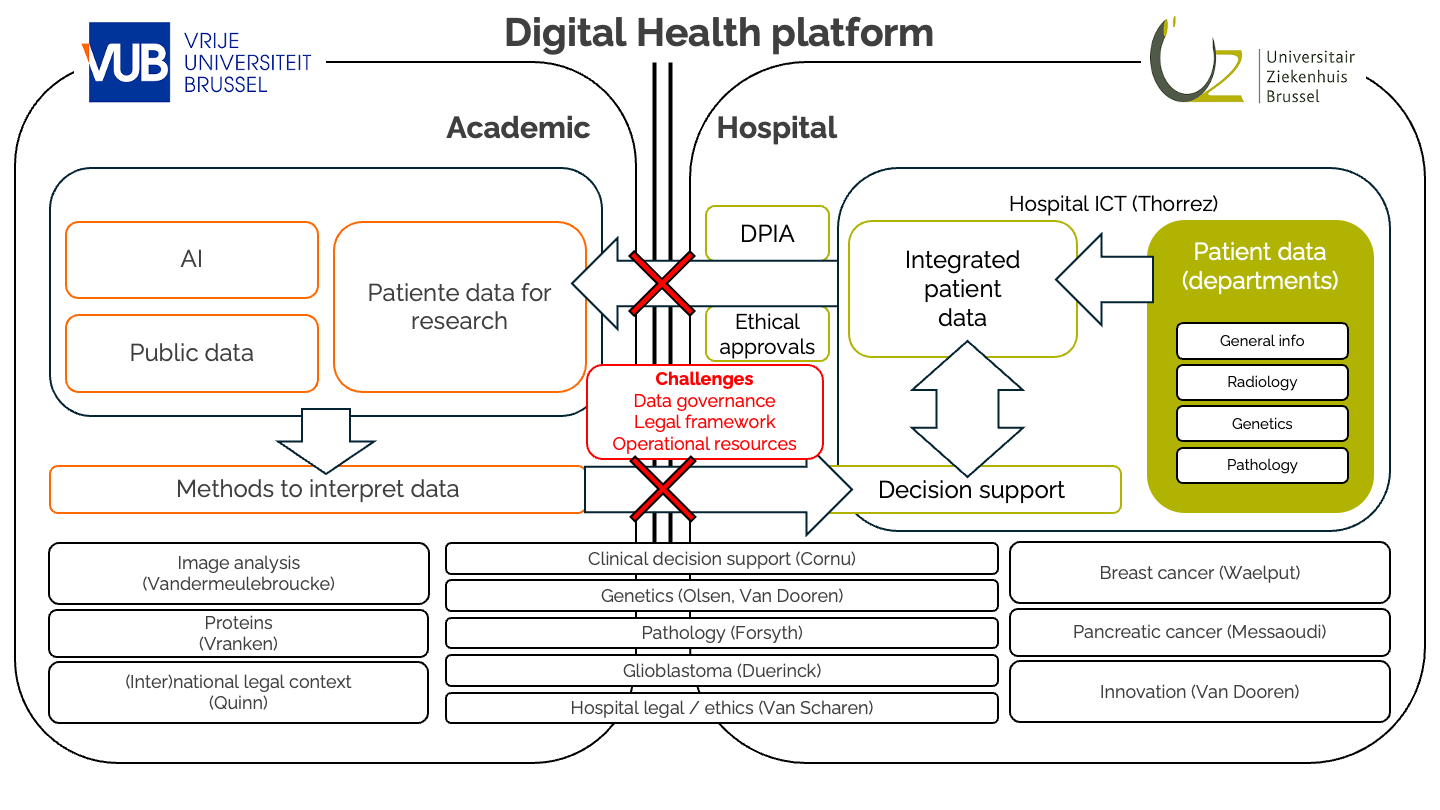
In the TumorScope project, we are aiming to advance digital health research by building on our consortium’s unique interdisciplinary expertise in AI, hospital ICT, cancer therapy, ethics, and legal aspects, while also leveraging existing data at the UZB and VUB (Figure 1). The technical, innovative, and legal challenges, as well as the issues surrounding data quality and standardization for a digital health platform, are being addressed through a series of joint PhD projects. The focus here is on the central development of AI-driven methods that combine molecular data with population, clinical, and radiomics image data for patient data analysis. Concomitant, investigations are being conducted on the legal and ethical issues surrounding the development and use of such AI methods.
We are focusing on cancer, initially glioma, a highly complex disease that involves multi-modal patient-related data. Research on this requires methods for advanced data integration and analysis, which is the most relevant challenge that has a significant potential for impact. Our insights will feed back to the hospital level and will be translated into practical solutions that comply with European and Belgian legislation and ethical standards, thereby facilitating the integration of AI-based solutions for improving treatment outcomes for cancer patient.
In addition, TumorScope is also about building a community of researchers and clinicians at the VUB and the UZB to inform them about the rapid developments in data generation and AI. We want to dispel misconceptions and provide a realistic view of the possibilities and challenges presented by digital health solutions. This applies to patients as well.
In the longer term, TumorScope aims to expand its research results regarding glioma patient data to other types of cancers, pathologies, and disciplines as well. The ultimate goal is to implement AI-driven clinical decision support solutions for multiple pathologies in the whole hospital. We also aim to continue to bring together researchers and clinicians from VUB and UZB through joint PhDs, annual workshops, new project applications for digital health-related methodologies within their legal setting... and so on. The connections we build during this project, will be leveraged to obtain additional European and national project funding, thereby continuing to strengthen the community and research at VUB/UZB in this upcoming and promising, but very complex, field.
Work Packages
WP1: Development of a multi-modal data capable AI pipeline for glioma molecular subtyping.
Individual elements, some of which are already developed (e.g. D2Deep, tumour subgroup segmentation), will be joined to work on multi-modal data, enabling combined analysis of radiology images with mapped molecular -omics data for exploration (e.g. identifying new tumor subregions) and accurate identification of surgical margins and prognosis prediction. Within this project, we will initially use high-quality public data to enable AI method development, after which in-hospital data from institutional clinical trials in glioma for currently around 150 patients will be used for further development/specification as well as validation. This research is performed by Anass Hamdi and, if funding allows, later in the project, it will be extended to Pancreatic ductal adenocarcinoma (PDAC), with the aim to advancing subtype-specific (immunomodulatory) therapies.
WP2: An integrated digital health data platform at the UZB.
During a nice collaboration between VUB and UZB, the scope and requirements of an integrated clinical health data platform that can be used for research, will be defined, enabling testing of the WP1 AI methodology on integrated UZB data. With the help of ICT software engineer Andre Silva both VUB and UZB requirements towards a trusted research environment will be implemented, allowing patient health data sharing and processing in line with the requirements and guidelines of the EHDS. Initially, focus is on glioma patients, with clinical information being linked to, among other sources, imaging and molecular information, and a specific integration of computational pathology (Kevin De Martelaere).
The pathology department is transitioning to digitalizing glass sections to whole slide images (WSIs), and benefits from a specialized digital on-line viewer for telepathology (Pathomation™), enabling remote collaboration and data repository. The specific focus of Kevin is on the analysis of pathology data in relation to other information.
WP3: The impact and local application of legal frameworks for digital health.
As part of this work package, PhD researcher Karen Cruyt examines the governance and secondary use of clinical data from oncological research in data-driven and cloud-based research environments. She analyses how such data can be reused for scientific research in compliance with an evolving European regulatory landscape, including the EHDS, GDPR, DGA, DA, and relevant sector-specific and national legislation. The research focuses on how these overlapping legal frameworks are interpreted and applied in practice, identifying inconsistencies, legal uncertainties, and barriers to data access and reuse. It also seeks to clarify the roles and responsibilities of key stakeholders, including clinicians, researchers, data protection officers, legal advisors, ethics committees, and patients, with particular attention to differences between legal theory and clinical reality.
Using an empirical legal research approach, combining legal analysis with qualitative interviews and observations, stakeholder perspectives are captured and gaps between regulation and practice are identified. A central component is the patient perspective, exploring issues of transparency, trust, and consent in the use of health data and biological materials for research. If possible, an additional PhD-student (not yet assigned) will explore the influence of the European regulatory framework, the AI Act and the MDR, on innovative AI research, its ethical impact and its possible translation to a medical device while ensuring patient safety and the role of IRBs.
WP4: Coordination and management.
Connections and regular meetings between the partners are being well managed by our project manager Arne Witdouck. Workshops are being planned for the wider community, the website is maintained, and FAIR training materials are being created within this work package.